
AI Recruitment in India: What's Really Changing in How Companies Hire
This isn't a story about robots taking over recruiting. It's about what happens when speed, scale, and better analytics get added to a hiring process that ran on human bandwidth for decades — and why staffing firms are feeling the shift first.
Why AI recruitment in India is accelerating right now
Several trends are converging at once. The white-collar job market in India keeps growing, IT recruitment has picked up pace, and firms in BPOs, retail, BFSI, and logistics are hiring in numbers manual screening simply can't keep up with. Add to that candidates who expect instant responses and recruiters under pressure to decide fast, and the old routine — job ads, manual resume sorting, endless phone rounds, spreadsheet-heavy HR teams — starts to break down.
The figures back this up. India recorded 290,256 AI-linked job openings in 2025, projected to grow 32% YoY in 2026 to nearly 380,000, led by IT software, BFSI, and manufacturing. Separately, AI/ML hiring within India's IT sector climbed roughly 40–49% YoY in early 2026, with Indian multinationals expanding AI-related hiring even faster than foreign MNCs operating in the country. Both numbers point to the same underlying reality: this is infrastructure reshaping how every major employer plans its talent pipeline.
(Sources: foundit/SiliconIndia, 2026)
What AI is actually doing inside the hiring funnel
AI recruitment in India is transforming the logistics of hiring far more than it's transforming the decision itself. Most of the automation sits at the front end of the funnel — exactly where traffic is highest and costliest.
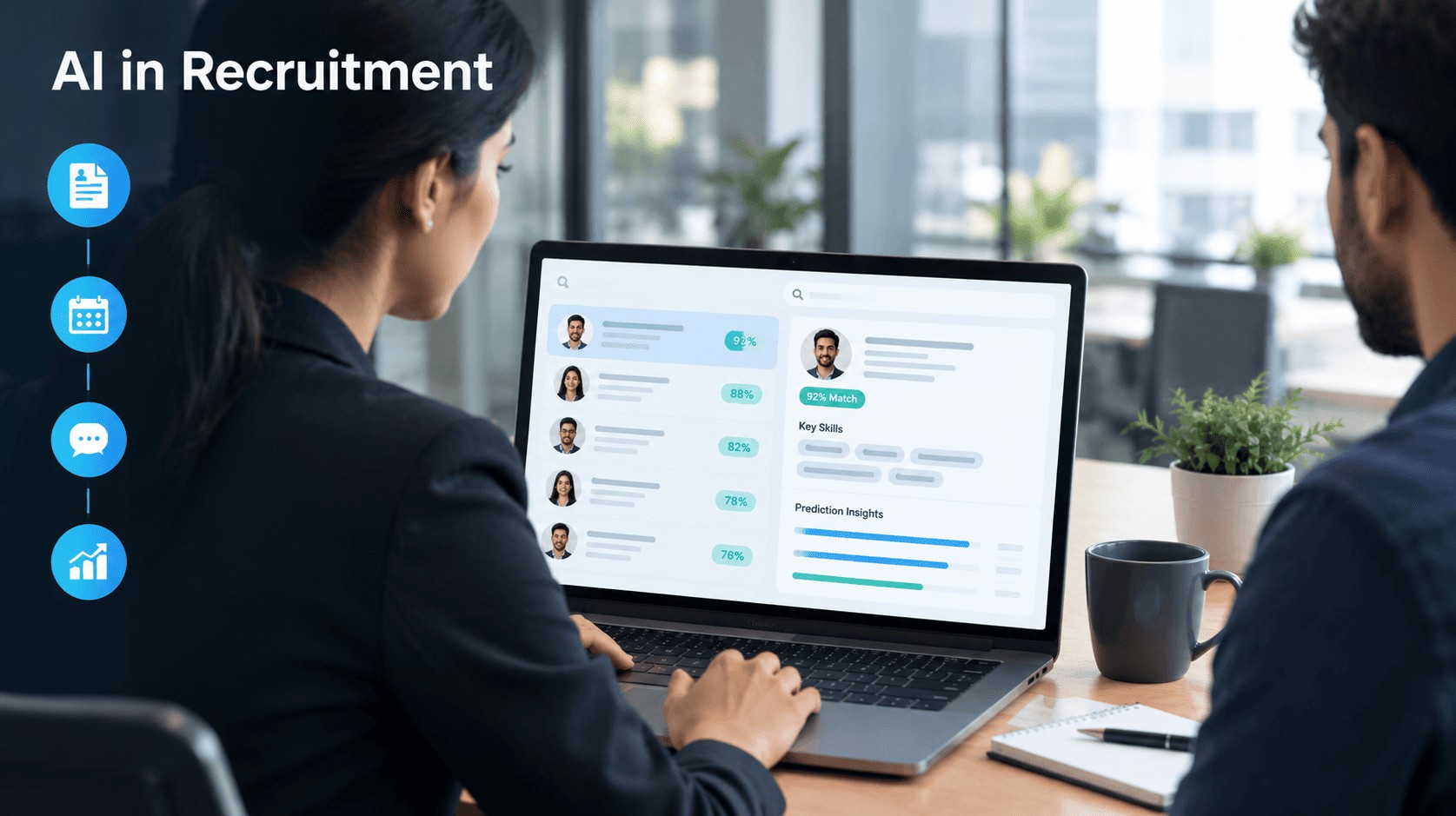
- Resume screening and shortlistingNLP evaluates resumes the way an experienced recruiter would — for skills, experience, and context, not just keywords. For high-volume employers running hundreds of mandates at once, this alone saves enormous time.
- Interview schedulingCoordinating slots across recruiters, hiring managers, and candidates used to eat up hours every week. Automated scheduling streamlines multi-round processes, and staffing agencies juggling several clients at once feel the workload drop immediately.
- Candidate engagementChatbots answer questions, send updates, and keep candidates informed in real time — a real differentiator when top candidates are weighing multiple offers.
- Predictive scoringMachine learning ranks candidates using patterns drawn from past hires, giving recruiters a data layer behind decisions that used to rest on instinct alone.
How this is reshaping hiring decisions
Recruitment in India is changing less in speed and more in how decisions get made. A hiring manager's gut instinct used to be the final word; now it's backed up by a dashboard.
Recruiters reviewing a shortlist can see skill scores, predicted job-fit, and even attrition risk, all calculated from data on past hiring outcomes. This isn't meant to remove human judgment — the recruiter still assesses whether a candidate's personality and communication style fit the team. But for volume recruitment, this shift matters most: firms placing hundreds of people a month across BFSI, IT services, and manufacturing can no longer defend recommendations on gut feel alone, and clients increasingly expect evidence when a hiring decision is questioned later.
The staffing industry is where the change is most visible
Staffing firms feel this shift more than anyone — they operate at a scale and speed manual processes simply can't sustain. AI now touches nearly every stage of their work: resume parsing, candidate ranking, automated interview scheduling, and even early-stage video interview analysis that flags communication strengths or red flags before a human recruiter gets on a call.
The result isn't fewer recruiters. Most agencies report client-facing headcount has stayed steady or grown — what's actually shrinking is the hours spent on administrative work per hire, freeing recruiters for relationship management and client strategy.
Where performance management software fits into the picture
This transition connects to another area companies are investing in: performance management software. Forward-thinking organisations and their corporate clients are now linking recruitment data with performance management systems, because early hiring decisions can only be validated by how someone actually performs months later.
How Indian companies are actually rolling this out
AI recruitment in India is rarely deployed in one shot. Organisations typically start small — AI-based resume screening for one role, or AI interview scheduling for a single business unit — partly because many Indian ATS and HRMS systems were never built with AI integration in mind.
| Sector | Adoption driver |
|---|---|
| IT services & GCCs | Data infrastructure, global hiring experience |
| BFSI & manufacturing | High graduate volume, compliance-driven hiring |
| Retail, BPO & logistics | Speed to fill seasonal hiring peaks |
| Shared trait across sectors | No one expects full automation |
The risks nobody should skip past
None of this comes without friction. AI systems trained on historical hiring data can inherit the same biases that shaped past decisions — if certain profiles were favoured before, an algorithm can quietly repeat that pattern unless it's actively monitored. Data privacy is another live concern, particularly with India's DPDP Act now shaping how candidate information, assessment scores, and interview recordings must be stored and handled.
- Inherited bias — models trained on past hiring data can replicate old patterns unless actively audited.
- DPDP Act compliance — candidate data, scores, and interview recordings now carry specific storage and handling obligations.
- Over-automation — recruiters risk being unable to explain why one candidate outranked another if the tool becomes a black box.
- Recommendation, not decision — most Indian employers keep AI as a ranking layer, with recruiters still reviewing shortlisted applications before any final call.
What this means for companies hiring in India right now
AI recruitment in India isn't replacing recruiters, and it isn't a silver bullet. What it's actually doing is compressing the time between job posting and offer letter, giving hiring teams data-driven insight they didn't have before, and pushing both in-house HR teams and staffing companies toward a process that's faster, more measurable, and — paired with strong human oversight — considerably fairer than what came before.
The employers investing now in interview scheduling automation, performance management software, and tighter data-driven feedback loops are the ones who'll be making faster, better hiring decisions a year from today.
Building an AI-ready hiring process?
YOMA Business Solutions has already built this shift into how we manage hiring for our clients — from resume screening to performance-linked feedback loops. Happy to talk through where to start.
Talk to YOMA →