Everyone in an HR leadership role knows firsthand what it’s like to get buried in spreadsheets during payroll processing, chase down managers for their performance review forms, and spend half the day responding to the same questions from employees over and over again. There is always another task list, but it takes a different form each time.
It is for this reason exactly that the idea of HR automation has evolved from being discussed merely as a nice option in boardrooms into a business imperative that is unavoidable.
In the following guide, all you need to know about HR automation will be covered, including what it actually entails, where it makes the most impact, and how to implement it properly.
What Is HR Automation?
But then, what is HR automation? Essentially, HR automation involves the utilization of digital solutions such as software and intelligent technologies to conduct and facilitate human resource processes with minimal human effort. What does it do? Its primary aim is simple free HR professionals from the mundane, repetitive tasks so they can work on more strategic and value-based assignments.
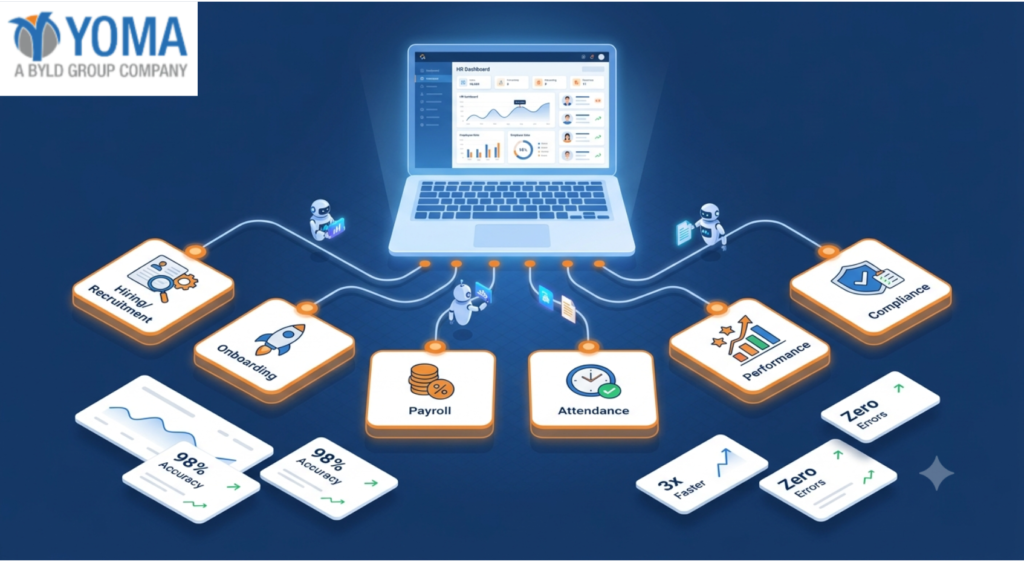
Now, what is HR automation from a technological perspective? A blend of multiple technologies used together, such as HRIS systems, ATS, chatbots based on artificial intelligence, Robotic Process Automation (RPA), ML algorithms, and NLP engines among other technologies. But what is the point? The point here is that HR automation technology should work collectively without any siloed approach throughout the employee’s tenure.
According to a study by Deloitte, 33% of companies have already fully automated at least one HR function, and that number is growing rapidly as more organisations recognise the value of HR automation.
What is HR automation doing for the future of work? It is fundamentally reshaping how HR departments operate, turning reactive, paper-heavy functions into proactive, data-driven engines for business growth.
The Core Areas of Automation in HR
Automation in HR must be understood based on how automation can be achieved in different areas of use throughout the entire employment process cycle.
The concept of automation in HR includes recruiting and hiring, induction, payroll, attendance tracking, performance appraisal, training and development, benefits management, compliance, and finally termination of employment. These are areas that when done manually, carry risks, time and cost involved.
Recruitment and Onboarding
HR automation revolutionizes the recruitment process, turning it from being reactive and paperwork-intensive to proactive and evidence-based. Through artificial intelligence, resumes are screened against job requirements within seconds, ranked in terms of suitability, automatic scheduling of interviews, and sending automated communication prompts in every stage of the process.
Onboarding is just as efficient. Once a candidate has been deemed hired, the entire process can be initiated automatically – from sending out offer letters to conducting background checks, setting up software permissions, arranging orientation sessions, and opening payroll accounts for the recruit, all before he even steps foot on Day 1.
Payroll Processing
Payroll is one of the riskiest HR processes and one that is most prone to errors by humans. Payroll HR process automation is the safest because it uses data from attendance software and applies statutory deduction principles automatically.
The HR process automation in payroll includes the handling of salary payment in bulk, statutory obligations, PF, ESI, and TDS in the Indian context, variable pay computation, payslip generation, and maintains the audit trail of all transactions. Employees can access payslips and lodge complaints using self-service portals without ever visiting the HR counter.
Time, Attendance, and Leave Management
Manually logging attendances, whether via punch cards, written records, or independent spreadsheets, is a drain on administration resources. HR process automation in such scenarios takes place via biometrics, geofencing, GPS attendance, and mobile clocking.
This allows for seamless integration into the payroll system, ensuring that leave encashment, overtime payment, and salary based on attendance is always done without issues. Dynamic approval processes and regional holiday calendars ensure less friction is caused within decentralized work environments.
Performance Management
Performance management is one such area where automation has proven to be strategically important. The system automates everything involved in the process – including setting up objectives based on OKR and MBO methodology, mid-year reviews, 360-degree reviews, feedback, and evaluations through automated reminders.
AI-driven analytics find out top performers and help detect individuals at risk of leaving an organization. They help find patterns that assist decision making regarding promotions and development. In this way, the system turns the annual process of performance management into an ongoing dialogue.
Learning and Development
The automation of HR in the context of L&D is based on the use of adaptive learning technology which allows for personalizing the training process based on roles, skill deficiencies, and personal learning style. Based on artificial intelligence, course recommendations will appear right when needed, anywhere, and in any format.
For administrators involved in L&D, the automation of HR processes is associated with scheduling, enrollment procedures, course grades, certifications, and completion reports. Real-time dashboards allow monitoring of skills improvement within teams.
Benefits Administration and Compliance
Benefits administration handles complicated structures like flexible spending accounts, group health insurance, wellness programs, and retirement packages. Benefits are automatically updated according to any life event of employees like marriage, birth of a child, and relocation.
In terms of compliance, automated systems track any regulation changes and change HR policies accordingly. Such systems create audit reports, store electronic records, and detect loopholes that may turn into non-compliance issues. It is particularly important for companies operating in India due to its dynamic regulatory environment.
What Is HR Process Automation, and Why Does the Distinction Matter?
HR software gives you a tool. HR process automation gives your workflow the ability to think. The difference lies between a system that simply stores information and one that takes action.
The most straightforward approach to HR process automation would be when the system itself joins the workflow as one of the actors in it. In such cases, as an employee applies for leave, the system sends this request to the appropriate person, checks for any violations of company policies, records the changes in the attendance register and informs the accounting department of them without making a single move manually.
And it makes all the difference for HR managers choosing their technology stack. The main benefit from HR process automation appears when configuring rules and triggers and integrating them into your workflow. Otherwise, buying an HRIS and keeping everything manual is wasted effort and money.
HR Automation Benefits That Actually Matter to the Business
The conversation around HR automation benefits often stays at the surface level: “saves time,” “reduces errors.” That is true, but incomplete. Here are the HR automation benefits that directly impact business outcomes.
1. Operational Efficiency at Scale
One of the greatest advantages of using automation technology within the HR department is speed. Actions that would have taken days, like onboarding an entire group of new hires, processing the payroll of 5,000 workers, and generating a compliance report, will only take minutes. Speed will scale as the company grows, hence, there is no need for the HR department to expand with the rest of the organisation.
2. Accuracy That Protects the Business
Errors may be made in manual processing. For example, making a mistake in the payroll, missing a compliance deadline, or creating inaccurate employment records could result in complaints from employees or lawsuits against the company. Minimizing human errors in high-stake processes may be one of the most important benefits of effective HR automation.
3. A Better Employee Experience
Employees benefit from self-service portal features which allow them to manage their own HR requirements on their own time, including submitting leave requests, downloading pay slips, changing addresses, and registering for training. The ability to handle their own issues in just two minutes without the need to wait two days to receive an email response is one that clearly raises employee satisfaction and removes load off the HR department.
4. Data-Driven Decision Making
The automation process offers important insights into attendance, performance, attrition, and recruitment. These insights provide the HR team with information for making informed decisions instead of responding to issues reactively. Making strategic decisions based on facts rather than intuition is one of the most important benefits of using this type of technology.
5. Cost Optimisation
With automation of repetitive tasks, the HR department can focus on strategic issues without increasing staff numbers. Companies save money from reduced costs of paper processing, auditing and correcting errors, with an ROI achievable even within the first year of implementation.
6. Compliance Confidence
Regulatory environments, especially in India, with its evolving labour codes and DPDP Act obligations, require constant vigilance. Automating HR workflows ensures that rules are applied consistently and documentation is audit-ready at all times, reducing the risk of costly non-compliance.
The Challenges of HR Automation And How to Navigate Them
No honest guide to HR automation is complete without addressing the friction points. These are real, and they are worth planning for proactively rather than discovering mid-rollout.
- Change Resistance. Introducing new technology requires a culture shift. Employees and managers may fear job displacement or resist new ways of doing familiar things. Proactive communication, leadership sponsorship, and early, visible wins are essential to building genuine adoption, not just compliance.
- Data Privacy and Security. Automated HR systems deal with highly confidential employee data like salary details, medical data, and performance details. Robust data governance and role-based access control frameworks should be established along with privacy policies within organizations, particularly in light of the Digital Personal Data Protection (DPDP) Act, 2023, passed in India.
- Integration Complexity. Linking up new software to old systems is always the hardest challenge in implementing a project. Software that is well built for integration purposes and already has links to popular ERP, accounting, and IT software significantly lowers that risk. Bad integration planning results in data silos, which negate the whole point of automation.
- Reskilling the HR Team. Automation changes what HR professionals need to know. Teams need training not just on how to use tools, but on how to interpret the data those tools generate, design better process workflows, and translate analytics into action.
- AI Reliability and Bias. AI-driven features, resume screening, performance prediction, and flight risk scoring can reflect biases if the underlying training data is skewed. Regular audits of AI outputs and maintained human oversight for high-stakes decisions are non-negotiable governance requirements.
How to Implement HR Automation: A Step-by-Step Approach
Implementing HR automation does not require a “big bang” transformation. A phased, strategic approach reduces risk and builds organisational confidence over time. Here is a practical roadmap.
Step 1: Audit Your Current Processes
List all the activities that your HR team is responsible for performing today. Determine which of these activities can be considered repetitive, high-volume, error-prone, or time-consuming. Payroll processing, attendance recording, leave management, offer letter drafting, and compliance reporting are some tasks you should consider automating first.
Step 2: Define the Outcomes You Want
Before selecting tools, define success. Are you trying to reduce time-to-hire by 40%? Eliminate payroll errors? Improve new hire onboarding satisfaction scores? Clear outcome metrics make evaluation more objective and ROI measurement more credible.
Step 3: Select the Right Tools
Don’t stop at feature sets. Consider scalability – can this platform serve the needs of your organization three years down the line? Usability – can your management and staff use the solution, or will they simply ignore it? Integration – will this solution link up directly with your current payroll, accounting, ERP, and IT systems?
The best solutions provide full coverage and end-to-end integration as opposed to piecemeal functionality that leads to disconnected data and process flow.
Step 4: Plan the Integration
Work hand-in-hand with your IT department and the provider to plan the integration of these new tools with your current system. Data migration, API development, and user testing will all require competent guidance and enough time. This step being mishandled is the biggest reason for the failure of implementation.
Step 5: Train and Enable Your HR Team
Invest in a comprehensive training program that covers both technical use and process redesign. Identify an internal “automation champion”, someone who owns the platform, gathers cross-functional feedback, and drives continuous improvement over time.
Step 6: Go Live in Phases
Start with one or two high-impact processes; payroll and attendance are often good starting points because ROI is immediate and measurable. Expand the automation of HR processes gradually, using learnings from each phase to refine your approach before scaling.
Step 7: Monitor, Measure, and Iterate
Track KPIs against your pre-defined outcomes. Use the data the platform generates to identify gaps, optimise workflows, and build the business case for expanding automation across additional functions. HR automation is not a one-time project; it is an ongoing organisational capability that compounds in value over time.
Choosing the Right HR Automation Solutions
The market for HR automation solutions has expanded significantly, ranging from point tools for specific functions to comprehensive HCM platforms covering the full employee lifecycle.
When evaluating HR automation solutions, prioritise end-to-end process coverage, embedded AI and analytics capabilities, mobile-first design, and compliance alignment with India’s Labour Codes, PF/ESI regulations, and the DPDP Act. Look for proven implementation track records, strong customer support, and a clear product roadmap. Client references from organisations of similar size and sector are invaluable.
The best HR automation solutions are those that scale with your organisation, growing seamlessly from a few hundred employees to several thousand without requiring a disruptive platform change.
Beyond features, assess the vendor’s approach to data security, their update cadence when regulations change, and whether their implementation methodology is structured or ad hoc. The technology is only as good as the partner behind it.
According to McKinsey, organisations that integrate automation into their HR and operational functions report up to a 20–25% reduction in administrative costs alongside measurable improvements in employee satisfaction.
HR Automation in the Indian Context: What Makes It Different
For Indian organisations specifically, the case for HR automation carries a distinct set of considerations that go beyond the global playbook.
India’s regulatory landscape is complex and in active transition. The consolidation of 44 central labour laws into four Labour Codes, covering wages, industrial relations, social security, and occupational safety, is still being implemented across states at different timelines. Organisations operating across multiple states face the challenge of managing varying implementation dates, compliance thresholds, and reporting formats simultaneously. Manual processes simply cannot keep pace; automated systems that update rules in real time are the only scalable answer.
The workforce diversity in India adds another layer. A mid-sized Indian enterprise may employ full-time staff, contract workers, gig workers, apprentices, and trainees, all under different statutory frameworks with different PF, ESI, and gratuity obligations. The automation of HR processes that can handle this complexity, applying the right rules to the right employee category automatically, saves significant compliance risk and administrative effort.
India’s Digital Personal Data Protection (DPDP) Act, 2023, which governs how employee personal data is collected, stored, and processed, also requires HR functions to operate with a new level of discipline. Consent management, data minimisation, and the right to erasure are now legal obligations for HR teams. Purpose-built HR automation solutions that have data privacy controls built in, not bolted on, are increasingly the only defensible choice for Indian employers.
Finally, India’s hybrid and remote work landscape has accelerated the need for mobile-first, location-agnostic HR tools. From biometric alternatives for remote attendance to digital onboarding journeys for candidates joining from Tier 2 and Tier 3 cities, HR automation allows organisations to deliver consistent people experiences regardless of where employees are located.
The Future of HR Automation
HR automation is not a destination; it is a direction. As AI capabilities mature and workforce expectations evolve, the scope of what is possible will continue to expand at a pace.
Generative AI is already entering this space, drafting job descriptions, summarising performance data, generating personalised learning content, and powering conversational assistants that handle complex employee queries in natural language. What once required an HR executive’s intervention now resolves in seconds through an intelligent interface.
Agentic AI, systems that proactively take actions on behalf of users, is beginning to appear in recruiting and workforce planning tools. These systems do not just surface candidates; they initiate outreach, schedule interviews, and update applicant records autonomously. The recruiter’s role shifts from executor to reviewer.
Predictive workforce planning is emerging as the next frontier. HR systems that analyse internal talent data alongside external market signals will help organisations anticipate skill shortages, succession gaps, and attrition spikes before they occur, enabling genuinely proactive talent strategy rather than reactive firefighting.
For HR leaders, the strategic question is no longer “should we automate?” It is “how do we build the organisational capability to evolve our HR automation maturity continuously alongside the business?”
The organisations that will win the talent game in the next decade are those that treat the automation of HR processes not as a cost-cutting measure, but as an investment in the quality, speed, and intelligence of their people operations.
Conclusion
HR automation has moved well past the experimentation phase. It is now the operating standard for high-performing HR organisations, and the gap between those who have adopted it and those who have not is widening every year.
The case is clear: greater efficiency, fewer errors, better employee experiences, stronger compliance, and the strategic capacity to focus HR talent where it matters most. This shift is not about replacing HR professionals; it is about amplifying what they can do.
Whether you are just beginning to explore the right fit or looking to deepen an existing implementation, the path forward starts with a clear-eyed assessment of where your processes are today and where you want them to be.
HR automation, done right, will pay dividends in every hire made, every payroll run, and every employee experience delivered.
Frequently Asked Questions (FAQs)
It is the use of technology to execute human resource processes, such as payroll, recruitment, onboarding, and compliance, with minimal manual effort. It is relevant for any organisation with an HR function, regardless of size. While large enterprises have led adoption, mid-sized and growing businesses in India are increasingly investing in modern platforms to scale their people operations efficiently.
HR software provides tools for HR teams to manage data and tasks. Adding process intelligence means the system itself triggers actions, routes approvals, enforces rules, and connects workflows without manual prompting. The result is a system that does not just store information, it acts on it automatically.
The earliest wins typically include faster payroll processing, reduced administrative workload, fewer compliance errors, and improved employee self-service. Organisations also report faster onboarding timelines and better workforce data visibility, all measurable within the first few months of deployment.
For payroll specifically, the system pulls attendance and leave data automatically, applies statutory deduction logic PF, ESI, TDS), calculates variable pay, and disburses salaries without manual intervention at each step. Employees receive payslips via self-service portals, and finance teams get automated reconciliation reports.
Timelines vary based on organisational size, the number of processes being automated, and integration complexity. A focused rollout covering two or three core modules can go live in eight to twelve weeks. A full enterprise-wide implementation typically takes six to twelve months in well-managed phases.
No. While enterprise adoption is high, modern cloud-based platforms are increasingly designed for mid-sized businesses. Scalable pricing models make it practical for organisations with 200 to 2,000 employees to benefit from meaningful process automation without a large upfront investment.
Prioritise end-to-end process coverage, AI and analytics capabilities, mobile accessibility, compliance alignment with Indian labour law and the DPDP Act, and integration capability with existing systems. The right HR automation solutions will also have a strong vendor track record with organisations of a similar size and sector.
Yes, well-built platforms are designed to stay current with statutory requirements, including Labour Code compliance, PF/ESI filing, TDS calculations, and data handling obligations under the DPDP Act, 2023. Always verify that the platform updates automatically when regulations change, rather than requiring manual reconfiguration.
It does not eliminate HR professionals; it changes what they spend their time on. Routine administrative tasks move to the system; HR professionals move toward strategy, culture, talent development, and employee relations. Most organisations find their teams more effective and more strategically valued after implementation, not smaller.
Begin with a process audit: map every task your team handles, identify which are repetitive and high-volume, and prioritise those that carry the highest administrative cost or compliance risk. Define clear outcome metrics, evaluate your options, and begin with a focused pilot before scaling.